
<< Back
Pitney Bowes Global Ecommerce Study Finds Attractive Market Driven by a More Demanding, Frequent and Global Online Shopper
94% shop online; 70% shop cross-border
Retailers racing to keep up with consumer demand – 47% of online shoppers disappointed last holiday season
This press release features multimedia. View the full release here: http://www.businesswire.com/news/home/20171012005443/en/
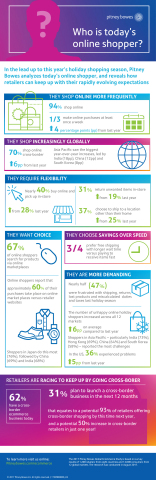
In the lead up to this year's holiday shopping season,
As retailers prepare for the upcoming holiday shopping season, the study offers a detailed portrait of trends impacting online retailers and consumers around the globe. Some of the study’s most interesting findings are summarized below:
For many online shoppers, 2016 was a holiday to forget…
According to the
Nearly half (47%) of online shoppers globally reported frustration with
everything from shipping, to returns, to lost products and miscalculated
duties and taxes during the 2016 holiday shopping season. What’s worse
is that the number of unhappy online holiday shoppers rose six
percentage points (pp) over the previous year and increased
year-over-year in every single one of the 12 major markets surveyed.
Shoppers in
“As consumers become more experienced with online shopping, they’re
shifting more of their holiday spend online and expecting better and
better service from retailers,” said
Snyder continued, “With even more purchases expected to be online this year, retailers need to double-down on the elements of the consumer experience that matter most – delivery, returns, tracking and world-class customer care.”
A more experienced, demanding, frequent and global online shopper
- Online shopping is ubiquitous in major global markets. 94% of consumers have made a domestic online purchase – flat year-over-year.
- Consumers are shopping online more frequently. More than one-third of global consumers make online purchases at least once per week (up 4 pp from the prior year).
-
70% of online shoppers have made a cross-border purchase (up 6 pp from
the previous year).
Asia Pacific saw the biggest year-over-year increases, led byIndia (18 pp),China (12 pp) andSouth Korea (8 pp). - Online shoppers are exercising a wider range of options when it comes to shipping, collecting, or returning their items:
This includes in-store pickups (“click-and-collect”), shipping to locations other than the buyer’s home, returning unwanted purchases in-store, and returning unwanted purchases using pre-paid shipping labels.
“Click-and-collect” – purchasing online and picking up in store – is now
common practice for 40% of global online shoppers, up from 28% the
previous year. In the US alone, this option is exercised by 46% of
online shoppers versus 27% in the previous year. The practice is most
common in
- Consumers prefer free shipping with longer delivery times (75%) over paying for expedited parcel shipments (25%).
Online shoppers increasingly prefer online marketplaces over retailer websites
-
67% of online shoppers turn to marketplaces like
Amazon ,eBay , Flipkart,Rakuten , Tmall andJD.com to search for products. This compares with search engines (46%), retail websites (40%), social media (24%), and mobile apps (23%). -
Online shoppers report that 62% of their cross-border purchases and
59% of their domestic purchases take place on online marketplaces,
versus retailer websites. These trends have increased year-over-year
and are most prevalent in
China ,Germany ,India andJapan . - Product assortment, better deals and easy checkout are the top three reasons consumers choose online marketplaces.
Retailers are beginning to recognize the growth opportunity in cross-border ecommerce. Business plans reveal a tipping point may be on the horizon.
- 62% of retailers have a cross-border ecommerce business today, and the vast majority of retailers who don’t offer cross-border, plan to in the next 12 months. If all of these retailers execute against their business plans, 93% will offer cross-border shopping by this time next year – that equates to a 50% increase in cross-border retailers in just one year.
- One-third of retailers rate “international selling” as a top growth lever for their business – equal to the value ascribed to domestic ecommerce growth.
- The average order value (AOV) of a cross-border purchase is 17% higher than a domestic AOV. But, cross-border retailers must balance the opportunity for higher AOV against consumer demand for lower prices. 50% of consumers who shop cross-border do so because of price.
Credit cards versus e-wallets – a dead heat…
-
Credit cards (like Visa and
MasterCard ) and e-wallets (likePayPal and Alipay) have been locked in a battle for payment option supremacy for several years. When asked what type of payment option they prefer when making a purchase outside of their home country, 41% of consumers chose e-wallets and 39% chose credit cards – the exact inverse of the results from the year prior. -
Preferred payment options vary by market. For example, US consumers
prefer credit cards (40%) over e-wallets (32%), while German and
Australian shoppers prefer e-wallets (
Germany 61%:26%;Australia 64%:23%). Credit cards are most popular inJapan (74%) andSouth Korea (65%).
“It is important that cross-border retailers focus on the consumers they are trying to reach; not necessarily the consumers they are most used to dealing with,” said Snyder. “That goes for developing their strategies around payment options and just about every aspect of their global ecommerce business.”
Three strategies for online retailers:
1. Take a cue (or two) from marketplaces.
a. Learn to love shipping. Low cost, fast, flexible and accurate shipping is key to attracting and retaining customers.
b. Personalize to convert: Implement customer information management solutions that aggregate a single view of the customer.
c. Expand your product assortment, offer timely promotions, and simplify checkout.
2. Go cross-border, but don’t rely on brand alone.
a. Localized marketing is essential because marketing channel preferences among consumers vary significantly by country.
b. Operational prowess separates the winners from the losers. This is particularly true in neighboring countries. The expectation is low cost and high visibility of delivery, localized customer care, and minimized duties and taxes.
3. Have the courage to go where the customers are.
a. When retailers implement cross-border strategies, they tend to start where the transition is easiest – neighboring countries with similar regulatory environments where people speak the same language. But, more often than not, the greatest opportunity for cross-border growth and success is further from home. Pitney Bowes’ analysis has found that the prioritization of near-border markets has come at the expense of underserving consumers in countries more apt to shop cross-border. Entering new markets with different cultures, languages and laws is complex, but the rewards can far outweigh the investment and challenges.
The 2017
Global Ecommerce Study is the latest industry research report from
About
View source version on businesswire.com: http://www.businesswire.com/news/home/20171012005443/en/
Source:
Pitney Bowes Global Ecommerce
Brett Cody, 203-351-6079
Director
of Communications
Brett.Cody@pb.com