
<< Back
Vaccinated and Unmasked – Pitney Bowes BOXpoll™ Shows Pandemic’s Impact on U.S. Consumer Shopping Habits
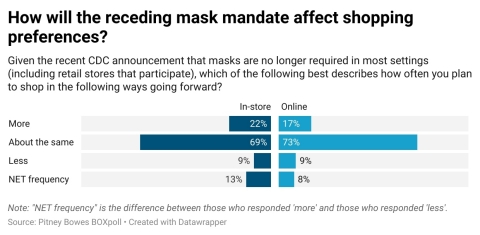
Consumers have mixed reactions to the easing of mask mandates: 22% will shop in-store more often while 17% will shop online more often
47% of consumers shop online more often today than before the pandemic
This press release features multimedia. View the full release here: https://www.businesswire.com/news/home/20210629005722/en/
Pitney Bowes BOXpoll consumer surveys show pandemic's impact on
Forty-seven percent of
What’s behind the decrease? The easing of mask mandates seems to have had some impact, as 22% of consumers say they will shop in-store more often as a result of mandates being eased, versus 17% who say they will shop online more often for the same reason.
Driving this divergence are the attitudes of those who are vaccinated, versus those who are not.
- Those planning to take a COVID-19 vaccine (about 12% of consumers) are significantly less likely to be shopping in-store moving forward (12% less, compared to 8% of all respondents). They’re also significantly more likely to be shopping online more often (33% vs 16% of all respondents).
-
Meanwhile, the behaviors of those who have already received at least one shot (57% of
U.S. adults) seem to be aligned with those who are not planning to get the vaccine (21% ofU.S. adults), with minimal difference in responses.
“The pandemic accelerated the shift from in-store to online shopping at a remarkable pace,” said
An elastic silver lining for fashion retailers. Americans buying more; bracketing less.
The reopening of stores, restaurants, entertainment venues and some offices are driving extraordinary year-over-year increases in clothing and accessory purchases. At the same time, the pandemic seems to have influenced fashion trends, at least in the near term. Namely, spandex may be woven into everything we wear now—at home, on the go, and even at work. BOXpoll found that the preference for comfortable clothing may be influencing another shopping trend that had fashion retailers anxious before the pandemic: bracketing – the practice of buying multiple sizes with the intent of returning what doesn’t fit.
-
Forty-one percent of all consumers (ages 18+) confess to bracketing, a 10pp decrease from a 2019
Pitney Bowes consumer survey, driven by a 9pp decrease among those who said they “always” or “frequently” bracket. -
Compared to last year—when few were buying clothes without an elastic waistband—only 8% of consumers say they bracket more often, and greater than 1 in 4 (28%) say they now bracket less than last year, totaling a net decrease of 20%
- Sixteen percent of millennials report bracketing more now versus last year
- Meanwhile, nearly 40% of Gen Z— the generation most affected by lower incomes and higher unemployment—report bracketing less than last year
Guarantee it.
BOXpoll also reveals the influence of delivery guarantees on consumers’ perceptions of – and behavior towards – a brand.
- Sixty-nine percent of consumers questioned agree that offering a delivery guarantee makes a retailer appear more trustworthy.
- Sixty-five percent say that seeing a delivery guarantee makes them more willing to buy from a retailer’s site
- Fifty-two percent would be more likely to buy from a retailer offering delivery guarantees than on offering fast shipping
- Parents are the most likely segment, at 53%, to buy from a higher-priced retailer who offers a delivery guarantee over a less-expensive retailer, offering the same product without a delivery guarantee.
- Groceries, vitamins, pet supplies and personal care items are the products consumers would like to see retailers offer guarantees for the most
Methodology
BOXpoll™ by
About
View source version on businesswire.com: https://www.businesswire.com/news/home/20210629005722/en/
(203) 218 1187
brett.cody@pb.com
Source: